
Who issues the permit?
Inside towns, the mayor is in charge of traffic and parking. Depending on the city, the permit is called an "arrêté de stationnement" (parking order), a "permis de stationnement" or, in Paris, an "AOT de déménagement". Applications go through the city's roads department, its police municipale or an online portal.
Deadlines
Each municipality sets its own minimum notice. Examples from official city websites: at least 15 days in Paris, 15 working days in Grenoble, 14 days in Nantes, 11 days in Bordeaux, 10 working days in Lille, one week in Lyon. Late applications are often refused.
Signs: the step people forget
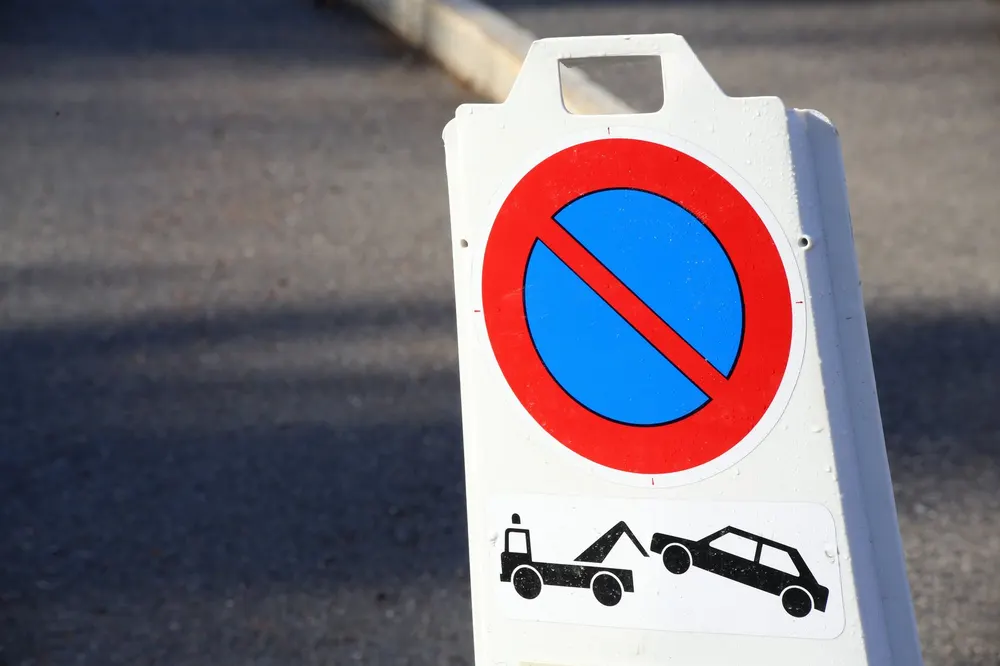
The permit alone does not keep the space free. In most towns, official no-parking signs must be placed before the date, within the timeframe set by the municipality, with a copy of the permit displayed: at least 24 hours before in Marseille, 48 hours in Nantes or Rouen, 72 hours in Strasbourg. Only then can the police have an obstructing vehicle towed.
Some cities place the signs themselves (Lyon, Grenoble); many provide nothing and leave it to the applicant. That is where we come in.
Paris is a special case
In Paris, the moving permit (AOT) is applied for online at least 15 days ahead, one for the departure address and one for the arrival address. It is not a reservation: no vehicle can be towed. To keep the space, you may reserve it yourself in advance ("ventousage"). Our sign installers do this with our signs, the AOT displayed.
Fines if you park without a permit
- Double parking ("stationnement gênant"): €35.
- Pavement, pedestrian crossing, cycle lane ("stationnement très gênant"): €135.
- In all cases the vehicle may be towed to the pound.
What the application usually requires
- the exact address, and both addresses for a move within the same town (two applications are needed in Paris, Bordeaux or Villeurbanne, for example);
- the dates and times;
- the number of spaces or the length requested;
- the size of the vehicle and often its registration number;
- sometimes a location plan, and the use of a furniture lift if any.
How many spaces to book
- Van up to 12 m³: about 2 spaces (10 m).
- 20 m³ removal van: 2 to 3 spaces (10 to 15 m).
- Truck of 30 m³ or more: 3 to 4 spaces (15 to 20 m).
- With a furniture lift: add the lift's footprint and safety area.
Furniture lifts and road closures
A furniture lift on the street almost always needs a specific permit: it is mandatory in Paris, and Marseille requires a safety area and a marked pedestrian path of at least 1.40 m. When the van and the lift leave no traffic lane, a traffic order and road-closed signs are needed, with longer deadlines: 20 days in Tours to close a street, 3 weeks in Courbevoie as soon as traffic is affected.
Municipal fees
Each town sets its own fee. Examples from official city websites: free in Bordeaux, Rouen or Besançon; €69 in Lyon and €68 in Villeurbanne, signs included; €33 per day and per vehicle in Aix-en-Provence; from €17 to €90 per vehicle in Paris depending on size, duration and location.
FAQ
Is the permit valid without signs?
In most municipalities, no: the ban must be signposted in advance, within the timeframe set by the town, to be enforceable.
Who pays the municipal fee?
The applicant. Some towns charge nothing (Bordeaux, Rouen), others charge per vehicle, per space or per day. We tell you the amount before you confirm.
Can a furniture lift be used on the street?
Usually only with a specific permit. In Paris, the AOT is mandatory to use a furniture lift.
Can I place the signs myself?
Where the town leaves signage to the applicant, yes, provided the signs are official and the permit is displayed. Placing no-parking signs without a permit has no legal value and can even be fined, as the City of Grenoble points out.
Is it different for a skip or a scaffolding?
Yes: a skip or a scaffolding on the street requires a permit to occupy the public highway, usually charged per unit or per square metre and per day. We handle these applications too.